Community story
In 1920, two young veterans filled All Saints Hall and named a new Legion post for a St. Peters sailor lost at sea. More than a century later, Post 313 still carries his name.
St. Peters, Missouri — St. Charles County
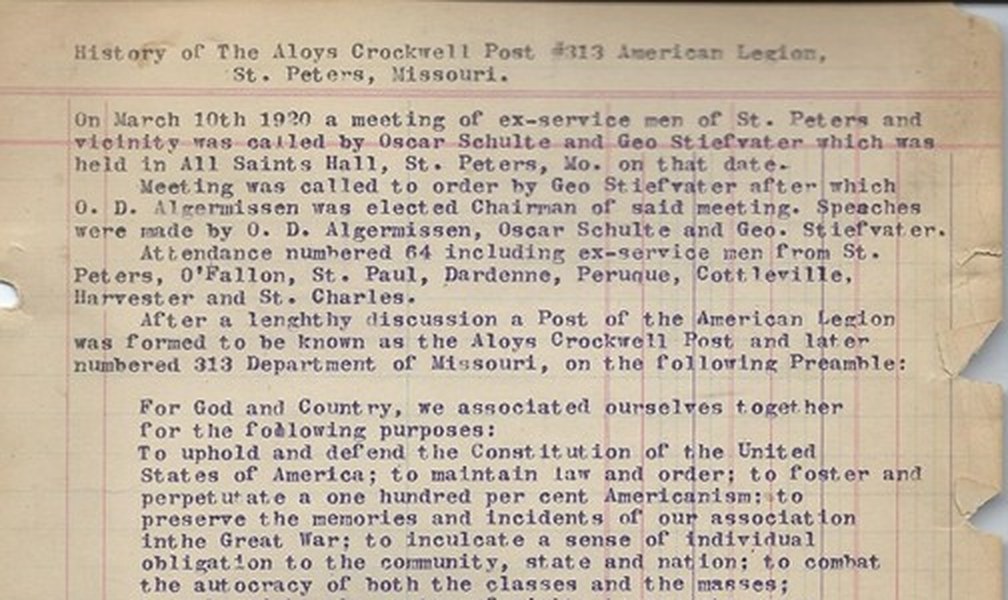
On March 10, 1920, a meeting of ex-servicemen filled All Saints Hall in St. Peters. Sixty-four people came, from St. Peters and O’Fallon, from St. Paul, Dardenne, Peruque, Cottleville, Harvester and St. Charles. Two young veterans, George Stiefvater and Oscar Schulte, had called it. After a long discussion, the room voted to form a post of the brand-new American Legion.
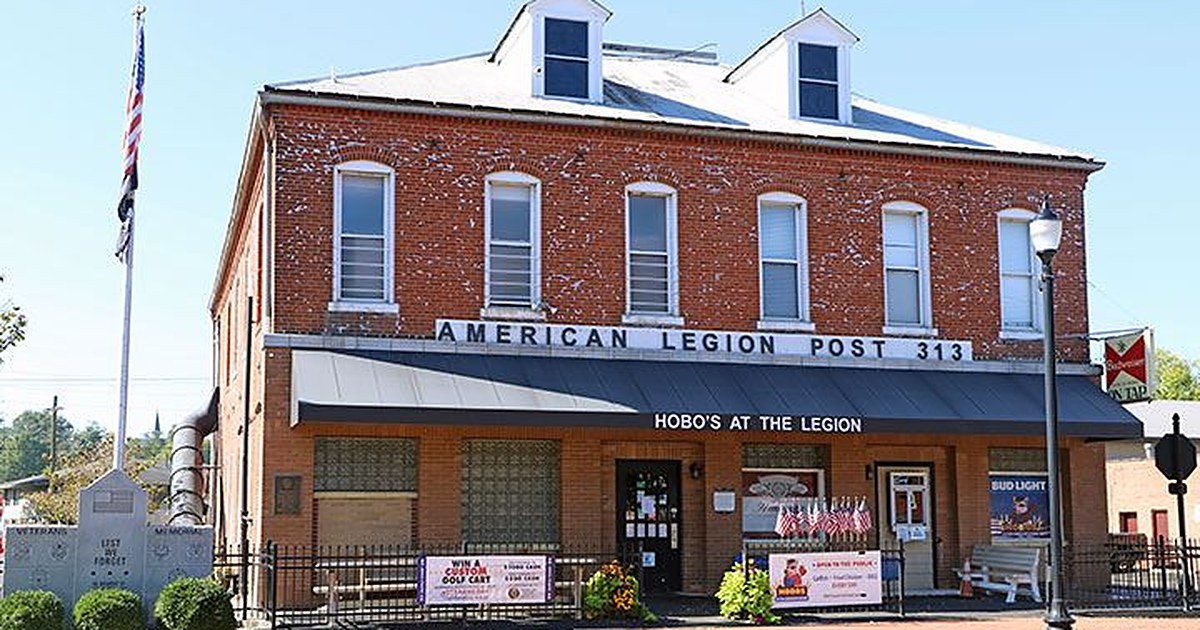
They did not name it for themselves, or for the town. They named it for a young sailor who had lived in St. Peters and did not come home: the Aloys Crockwell Post. The number came later. More than a century on, American Legion Post 313 still carries his name, and it still gathers on Main Street, in a brick building raised in 1870.
George Stiefvater was born in St. Peters on May 9, 1896, and served as a medic in World War I. The city’s Old Town history credits him and Oscar Schulte with organizing a post in 1919, the year after the Armistice. That was the same year the American Legion itself was born. Americans still serving in France held a founding caucus in Paris that March, and in May about 1,100 delegates met at the Shubert-Jefferson Theatre in St. Louis, where the Legion’s preamble and constitution took shape. Seventy-three of those delegates were Missourians.
The post’s own typewritten history picks up the story at that March 1920 meeting. The members set dues at $2 a year, with 50 cents staying in the post’s own treasury, and on April 5 they sent the state and national share along with their application for a charter. On May 7, 1920, the charter arrived from national headquarters in Indianapolis. A week later the members elected Stiefvater commander and Schulte adjutant.
The St. Peters names on the 1920 charter application, as they were typed:
Geo. Stiefvater, Leo Iffrig, O. D. Algermissen, Oscar Schulte, Oscar Mahon, Joseph Conoyer, James Conoyer, Mike Heintzelmann, Ed Shaw, Walter Hunn, Leo Zerr, Frk. Loeffler, Ray Doll, Dan Schneider, Ed Illy, Hy Boschert, Ben Algermissen and Fred Rieffer. Men from O’Fallon, St. Charles and Peruque signed on too.
Aloysius Henry Crockwell was born on January 11, 1896, in Raymond, Illinois, the same year as George Stiefvater. He worked for Standard Oil in Wood River, Illinois, then moved to St. Peters and took a job at the Sacred Heart Academy in St. Charles. On June 20, 1917, less than three months after the United States entered the war, he enlisted in the Navy.
He was assigned to USS Ticonderoga, a German freighter seized by the United States in 1917 and put to work carrying Army cargo, including vehicles and animals, to France. Crockwell served on her forward gun crew. When the St. Louis Post-Dispatch reported his loss in October 1918, it said he had made four trips across the Atlantic and had been home on furlough only a month before.
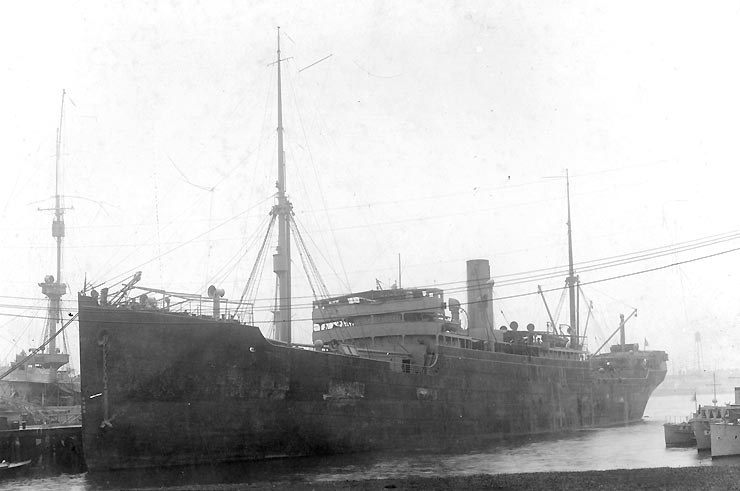
On September 22, 1918, the Ticonderoga left New York in a convoy bound for France. During the night of September 29 she developed engine trouble and fell behind. Early the next morning, lookouts spotted the German submarine U-152 on the surface. The fight lasted about two hours. The submarine’s shells knocked out the forward gun, Crockwell’s station, after it had fired six shots. The six-inch gun at the stern kept firing until it was silenced too. Nearly every man aboard was wounded, including her commander, Lieutenant Commander James J. Madison, who later received the Medal of Honor. At 7:45 a.m. the ship went down.
Of the 237 sailors and soldiers aboard, 24 survived. Twenty-two of them drifted in a single lifeboat for four days before a British steamer picked them up, and two officers were taken prisoner aboard the submarine. Aloys Crockwell’s body was never recovered. He is memorialized at Suresnes American Cemetery outside Paris. He died 42 days before the Armistice.
The new post went straight to work, and it raised money the way small towns always have. On Armistice Day 1920 it held a euchre party and dance in All Saints Hall that cleared $49.69. That December it screened the U.S. Signal Corps film of the 35th and 89th Divisions, two divisions full of Missouri men, and set the $50.72 it raised aside for a memorial to “the 4 home boys who made the supreme sacrifice,” Crockwell among them. In April 1921 a showing of The Lost Battalion, the 1919 film in which survivors of that famous unit played themselves, brought in $21.19 more.
The post looked after its neighbors, too. It secured the government’s Victory Medal and Missouri’s state medal for every ex-serviceman in the area, member or not, and paid the notary fees itself. Its officers turned out when veterans in Wentzville and O’Fallon organized posts of their own, and the post backed the O’Fallon post even though it meant losing members who lived near there. By December 1921 its list of officers included an athletic officer.
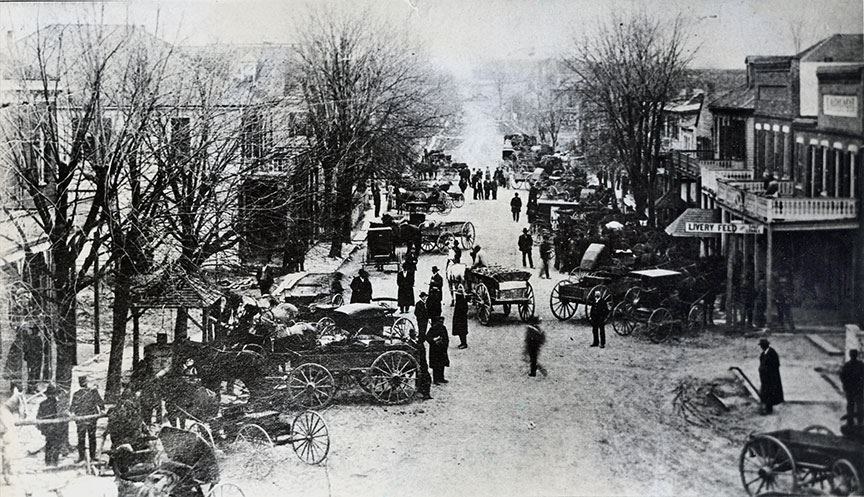
The post’s early records place its meetings in All Saints Hall, the Knights of Columbus hall and Spreckelmeyer’s Hall. The home it has kept ever since stands at 200 Main Street. The two-story brick building there dates to 1870, about fifteen years after the railroad reached St. Peters, and was known as the Weinerth Building. In 1945, as a second generation of veterans came home from World War II, it was renovated for the Legion. In 1946 the women of the post formed the American Legion Auxiliary, and in 1949 the building was dedicated as the Legion’s hall.
The St. Peters Historical Society put up a marker out front in 1985. Until 2010 the building was used almost entirely by the Legion. That year Hobo’s restaurant moved into the first floor and opened the old hall to the public. A veterans memorial engraved “Lest We Forget” stands beside it.
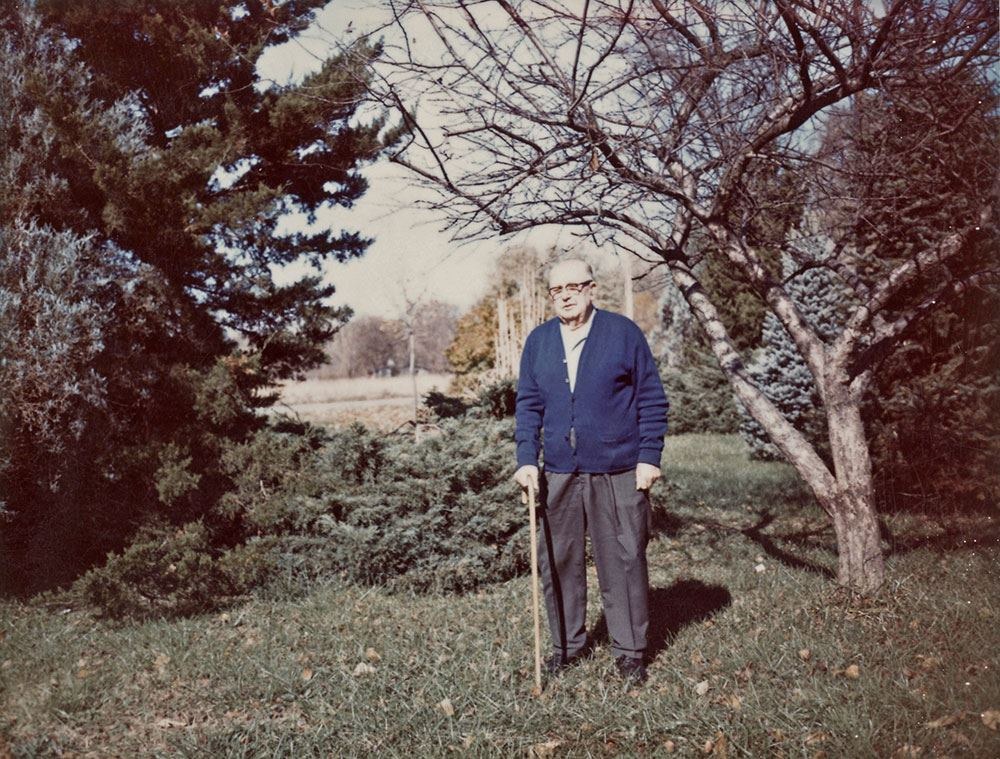
George Stiefvater stayed involved with the Legion for more than 30 years. Back home he ran a trucking company, a furniture store and a funeral parlor. In the 1940s he sat on the Chamber of Commerce board that bought the land for Old Town Park for $1,000, a purchase plenty of people called foolish. When a nursery offered to plant about six trees for $100, Stiefvater said he would plant them himself, and more. He ended up planting more than 300 beyond what is now right and center field, and watered and cared for them for years. That corner of the park is still called Stiefvater’s Grove.
Post 313’s Missouri Honor Guard No. 8 provides funeral honors at Jefferson Barracks National Cemetery and at local cemeteries. The post fields American Legion Baseball teams and helps send young men to Boys State. It has supported the Special Olympics, the St. Louis Veterans Home, the USO at Lambert airport, Wounded Warrior Project and Boy Scout Troop 760, and it funds a scholarship at All Saints School, which carries the same name as the hall where those 64 people met in 1920. The Auxiliary that formed in 1946 is still at work too, and today it runs the post’s Queen of Hearts raffle.
Do you see a grandfather or great-grandfather on that 1920 charter list? Share this story with your family. And the next time you are in Old Town, look for the 1870 building at 200 Main Street with “American Legion Post 313” across the front. It still bears the name of a sailor who never came home.
Top photo: American Legion Post 313 at 200 Main Street. Courtesy of the City of St. Peters. Sources: the post’s typewritten history and website; the City of St. Peters Old Town walking tour; the 1985 St. Peters Historical Society marker; the Mid America Veterans Museum; the Naval History and Heritage Command; and The American Legion.
Keep reading
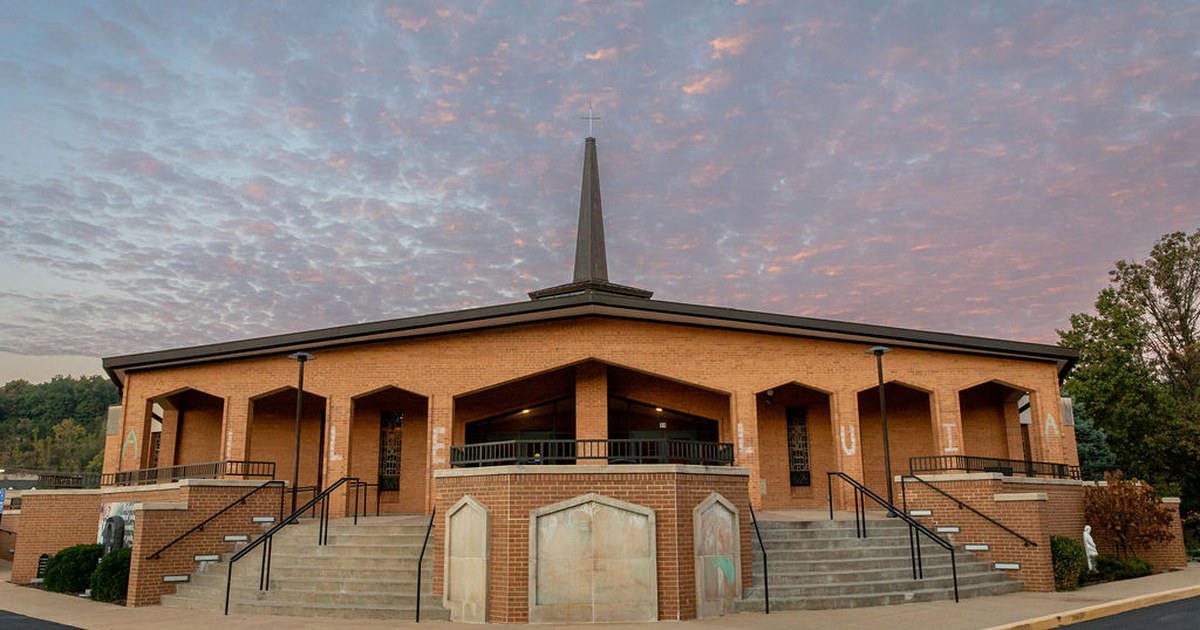
For 147 years, Fenton has shown up for St. Paul Catholic Church. Now the parish's Queen of Hearts jackpot is past $84,000, and only three cards remain.
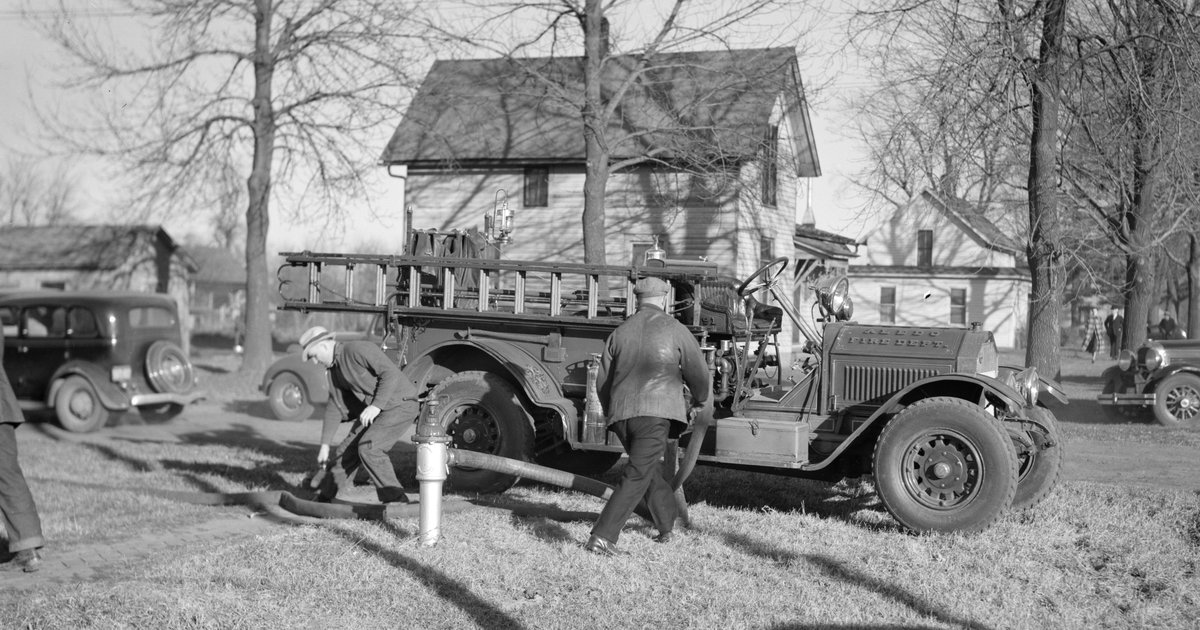
A 1917 Packard bought out of a junkyard for $325, a firehouse paid for in wine, an ambulance district that ran on collection jars: how neighbors around St. Louis built their own emergency services before 911
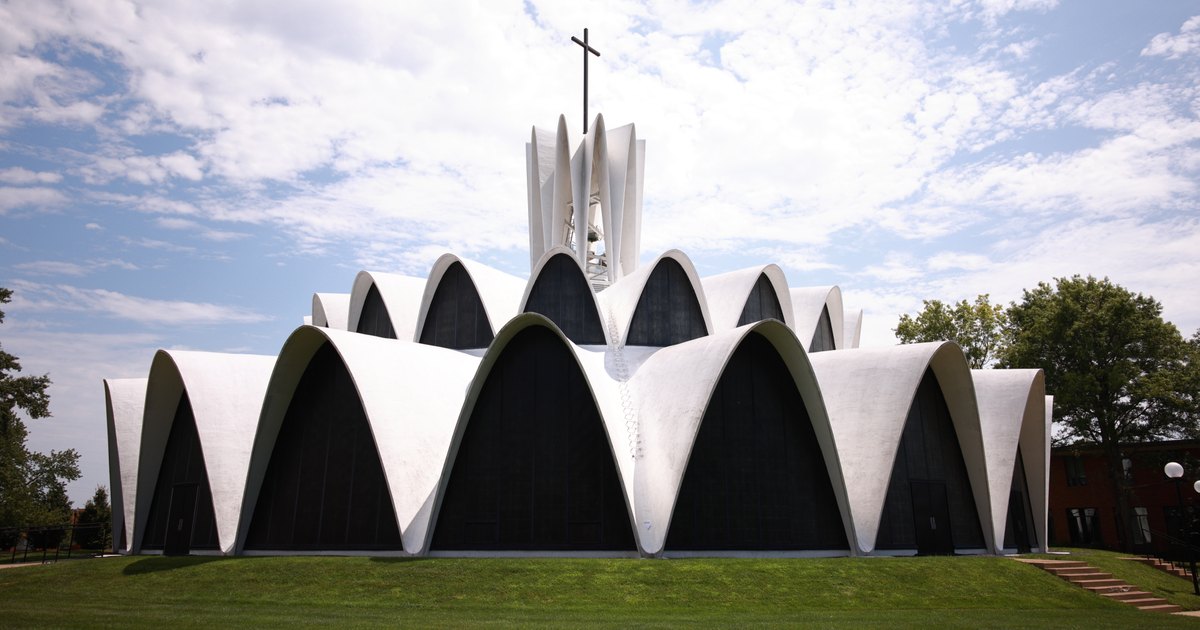
In 1955 St. Louis Catholics asked a Yorkshire abbey for monks to run a school for their sons. Three came, with no students, no classrooms and no playing fields. Seven decades later the monastery and school they started still stand on Mason Road.