St. Louis, Missouri — Florissant, Dutchtown, The Hill, Ferguson and Dogtown
In June 1825, in a field beside the new brick church in Florissant, more than twenty soldiers stood guard around an outdoor altar while a Jesuit priest raised the Blessed Sacrament. Several of the soldiers were Protestants. They fired their muskets anyway, before, during and after the Benediction, because that is what you did at a French Corpus Christi procession, and Florissant was still a French town.
Two hundred years later the same walk still happens in North County every June. So does a German one on the South Side that has not missed a year since 1878, an Italian bread altar on The Hill, a mariachi Mass for Our Lady of Guadalupe and a St. Patrick’s Day parade that draws tens of thousands to a neighborhood built by Irish clay miners. Every one of these began as homesickness. Each is now simply part of how St. Louis marks the year.
Florissant: Fête-Dieu on the Frontier
St. Ferdinand Parish was founded in 1789, when Florissant was a Spanish-governed village of French farmers, and its first church was a log cabin near what is now St. Denis Street. The brick church that replaced it, cornerstone laid in 1821, still stands as Old St. Ferdinand Shrine, the oldest church in north St. Louis County. Philippine Duchesne and four other nuns of the Sacred Heart had moved into the convent next door in 1819 to run a girls’ school, and the Jesuits who arrived soon after opened a school for Native American children on the same grounds.
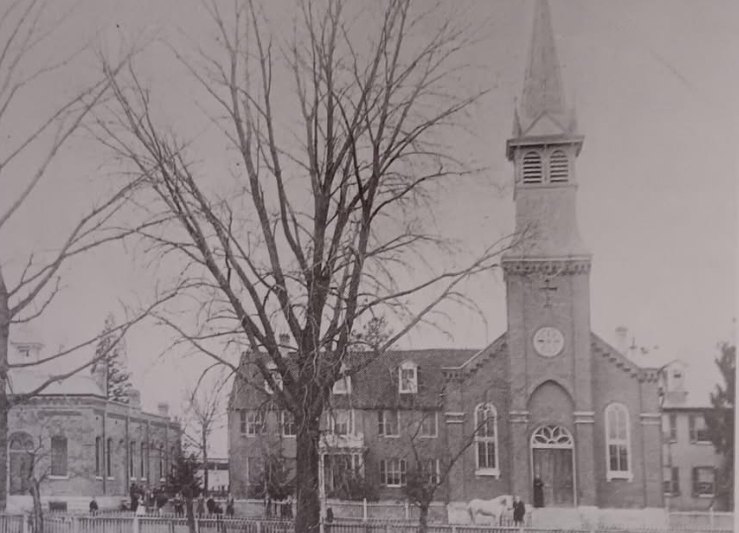
That is who was walking in 1825. Father Jacob Van Assche, one of the young Belgian Jesuits, wrote down the order of march. A Native American boy carried the cross. Four more in surplices rang handbells. Then came the Sunday-school children, the nuns with their boarders, the scholastics singing hymns, the deacon and subdeacon, and finally the Father Superior under the canopy with the monstrance, followed by a military guard. Children scattered flowers along the route. In the field next to the church the parish had built an altar “with the finest decorations we could procure.” In France this feast was Fête-Dieu, the Feast of God, and taking the Eucharist outside the church walls was the whole point: the town itself became the sanctuary for an afternoon.
Two years later Pierre-Jean De Smet was ordained in that church before heading west to the Rocky Mountain missions. The parish moved to a new building on Charbonier Road in 1957, and the old complex might have been torn down had a group of neighbors not formed the Friends of Old St. Ferdinand in 1958 and bought the deed from the archdiocese for one dollar. It went on the National Register in 1979 and became a shrine in 1988 after Duchesne was canonized.
Today: The Fête-Dieu never really left. In 2024 roughly 250 people walked the North County Corpus Christi procession from Sacred Heart Church through the streets of Old Town Florissant to the Shrine, praying the rosary behind a golden monstrance under a canopy, with a Florissant police escort in place of the musket guard.
Dutchtown: 148 Years Without Missing a June
By 1850, 43 percent of St. Louisans had been born in Ireland or Germany. The Germans spread across the South Side, and the farming settlement around what is now Meramec Street took the name Dutchtown, from Deutsch. In February 1863, in the middle of the Civil War, Archbishop Peter Richard Kenrick asked the Franciscans, who had come from Saxony to southern Illinois five years earlier, to open a German parish there. Father Servace Altmicks and three friars arrived to find 70 German-speaking families, 25 English-speaking ones and 117 children of school age. Until a church was built, Mass was said at the House of Refuge, an orphanage on the site of today’s Marquette Park.
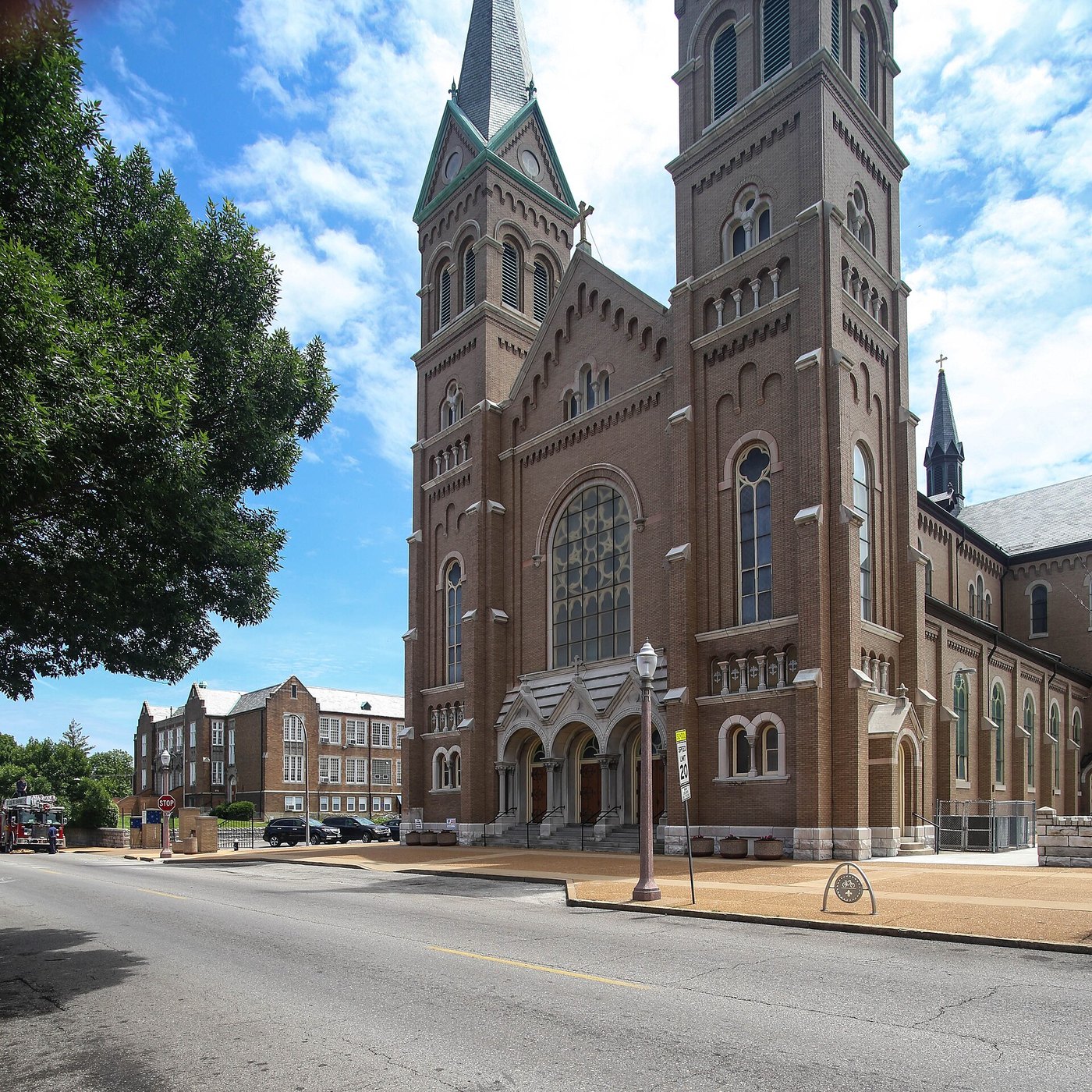
The parish’s fourth pastor, Father Vincent Halbfas, arrived in 1877 having watched Fronleichnam processions every June of his life in Germany. In 1878 he simply started one. Parishioners, school children, sodalities and a band carried the Blessed Sacrament through the neighborhood, stopping at outdoor altars built in front yards for Benediction. The procession has gone out every year since, through two world wars fought against Germany, through the decades when the parish stopped speaking German, and past the 1908 church whose twin spires are still the tallest thing in Dutchtown. The 2026 procession, on June 7, marked the 148th.
Today: It still begins at the end of Mass and makes three Benediction stops in the neighborhood, including one in the courtyard of Our Lady’s Inn, the maternity home nearby. The streets are blocked off, the altars are built, and the parish that first drew 70 families is now the keeper of one of the oldest unbroken religious traditions in the city.
The Hill: Bread for St. Joseph
Italians came to the high ground southwest of downtown in the 1880s for the same reason the Irish had gone to Dogtown next door: clay. The Cheltenham clay beds fed the brickworks and the mines needed men. Most of the first arrivals came from Lombardy in northern Italy, and they came in chains, one brother sending for the next, until by the 1920s The Hill was an Italian town inside an American one, with its own grocers, bakers, taverns and, eventually, its own church. St. Ambrose opened as a mission in 1903 under Father Lucian Carotti and became a parish in 1907. When the wooden church burned in 1921, parishioners pledged a dollar a month for five years to replace it, and in 1926 they dedicated the brick and terra-cotta church that architect Angelo Corrubia had modeled on the Basilica of Sant’Ambrogio in Milan. Two of its parish boys, Yogi Berra and Joe Garagiola, grew up across Elizabeth Avenue from each other.
The feast that defines the parish, though, is Sicilian. The story goes that in the Middle Ages a drought brought Sicily to the edge of starvation. The people prayed to St. Joseph, the rains came, and in thanks they set tables of food for the poor on his feast day, March 19. The St. Joseph’s Altar grew out of that promise: three tiers for the Trinity, a statue of Joseph holding the child Jesus at the top, and below him breads baked into the shape of his staff, crosses, Easter lambs and wreaths, along with cakes, cookies, fruit and fava beans, by tradition the crop that survived the drought.
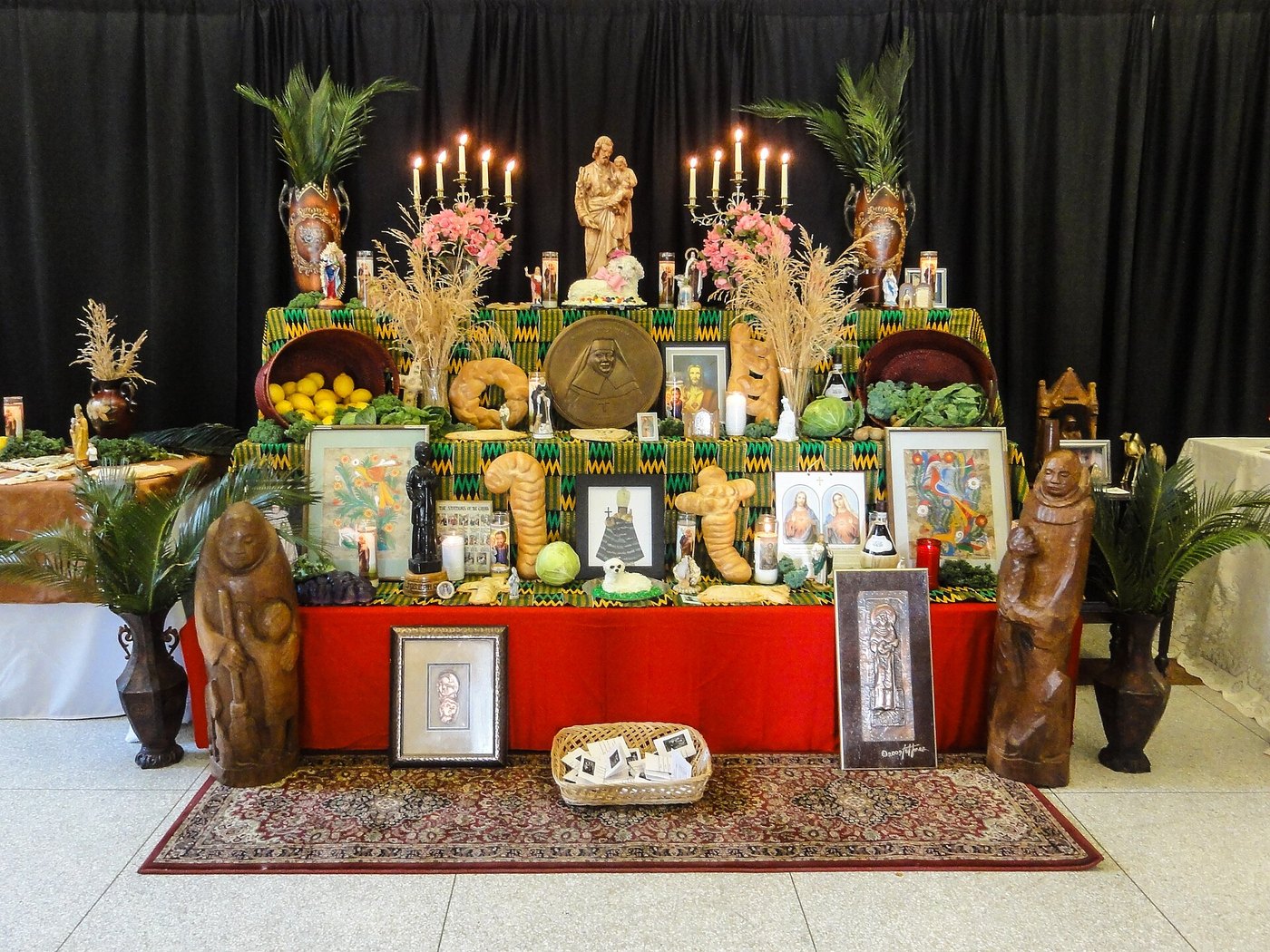
Today: St. Ambrose builds its altar on the Sunday nearest March 19 under the statue of St. Joseph inside the church. The bread is blessed at Mass and handed out afterward, the restaurants and bakeries of The Hill donate the rest, and the cookie sale that follows pays for tuition assistance at the parish school. About 890 families are registered, and every March the church is full of people who came from no further than Marconi Avenue, and from nowhere near Sicily.
Ferguson and St. Ann: Roses in December
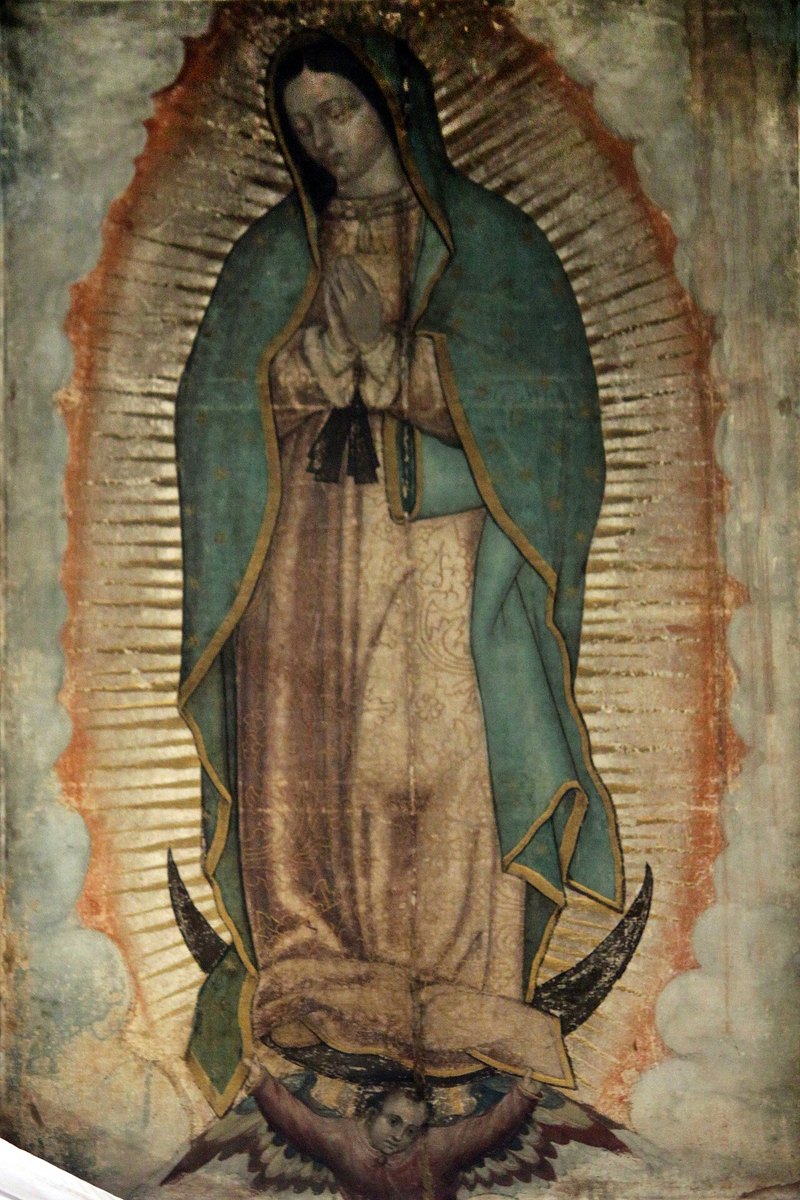
On December 12, 1531, according to the account that has shaped Mexican Catholicism ever since, the Virgin Mary appeared to an Indigenous convert named Juan Diego on Tepeyac hill outside Mexico City. When the bishop asked for a sign, Juan Diego opened his tilma, a cactus-fiber cloak, and Castilian roses, which do not bloom in December, spilled out. On the cloth was her image. The tilma hangs in the basilica at Tepeyac today, and the picture on it is on candles, car windows, tattoos and parish walls wherever Mexicans have gone.
St. Louis was never a major Mexican destination. The 2015 census figures put the metro area’s Hispanic population at about 75,000, under three percent of 2.8 million people, though Mexico was already the largest single source of the region’s immigrants. The parish that serves them has an older and odder history. Our Lady of Guadalupe in Ferguson was founded in 1954 as an ordinary suburban parish under Father Francis Kelly, on land bought from the Franciscan Sisters. The church and eight classrooms opened in the fall of 1955 with unfinished floors and temporary heat. It is now the archdiocese’s personal parish for Catholics of Hispanic origin or language, drawing from the whole region, and Sunday Mass is in Spanish at 9:30 and noon. A parish named for Guadalupe in 1954 turned out to have been waiting for its people.
Today: The feast looks the way it looks in Mexico. In December 2014 more than 300 people filled Holy Trinity in St. Ann. When the bell rang at noon they carried an image of the Virgin around the church singing in Spanish behind a mariachi band, dancers in red moved to a drum inside the sanctuary, the priest blessed the children and everyone went to the hall for lunch. In 2023 a Ferguson parishioner carried the statue into the feast at St. Charles Borromeo while children danced the matachines. The procession in Florissant in 1825 and the one in St. Ann in 2014 are separated by 189 years and a language. They are the same idea.
Dogtown: The Parade That Found Its Neighborhood
The Irish came to St. Louis in two waves and settled in two places. The famine emigrants of the 1840s packed into the Kerry Patch on the near North Side, a neighborhood so rough the city’s own history calls it violent and impoverished. A second cluster grew around Cheltenham, at today’s Hampton and Manchester, after the Pacific Railroad reached it in 1852 and the fire-clay mines and brickworks opened. The miners’ shanties became Dogtown. St. James the Greater began in 1860 as a mission of St. Malachy’s, staffed by priests straight from Ireland; Richard Tobin built the first church in 1861. It burned in 1891. The second burned in 1919. The third, finished in 1928 and modeled on the cathedral at Cobh, the port millions of Irish emigrants sailed from, is the one on Tamm Avenue now.
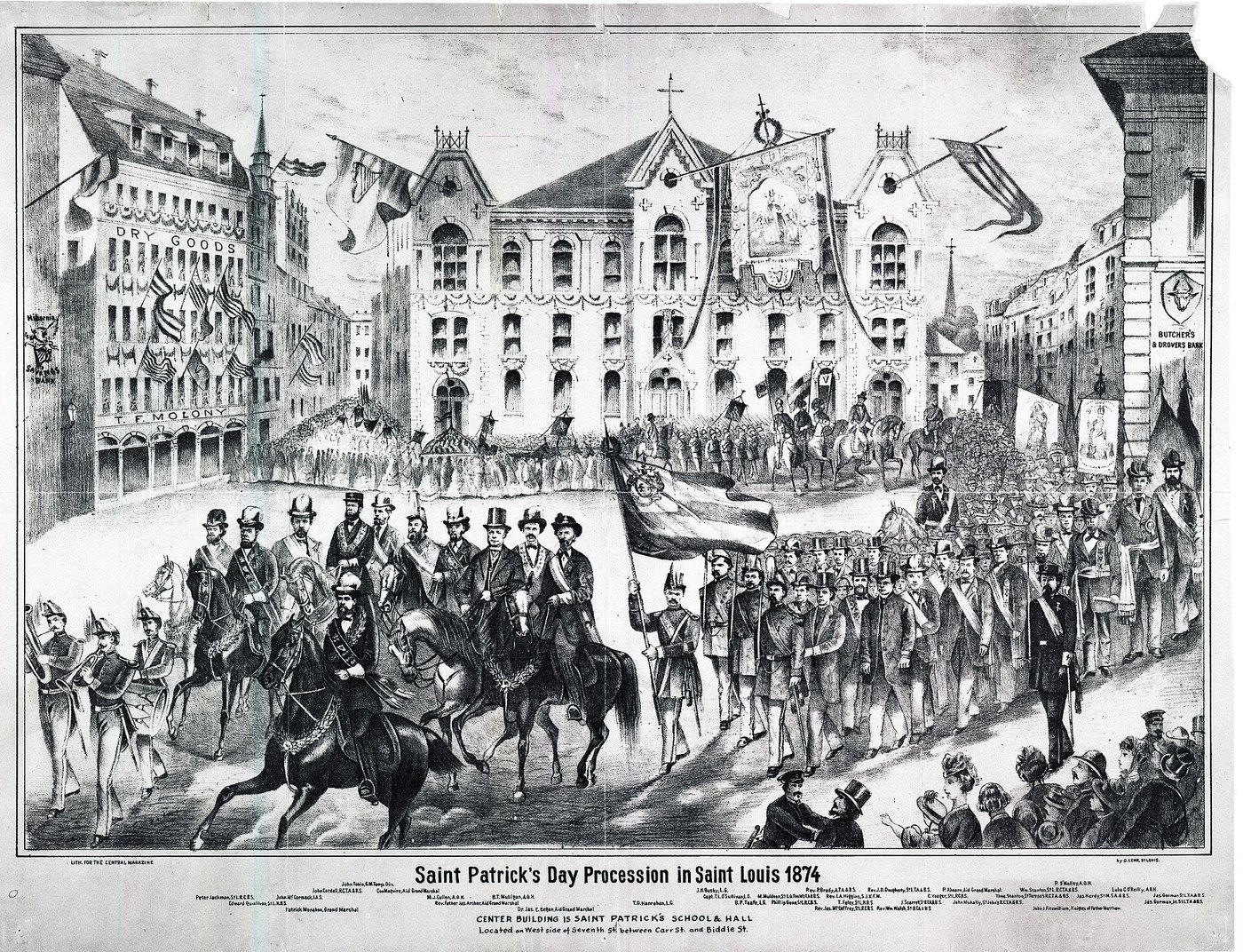
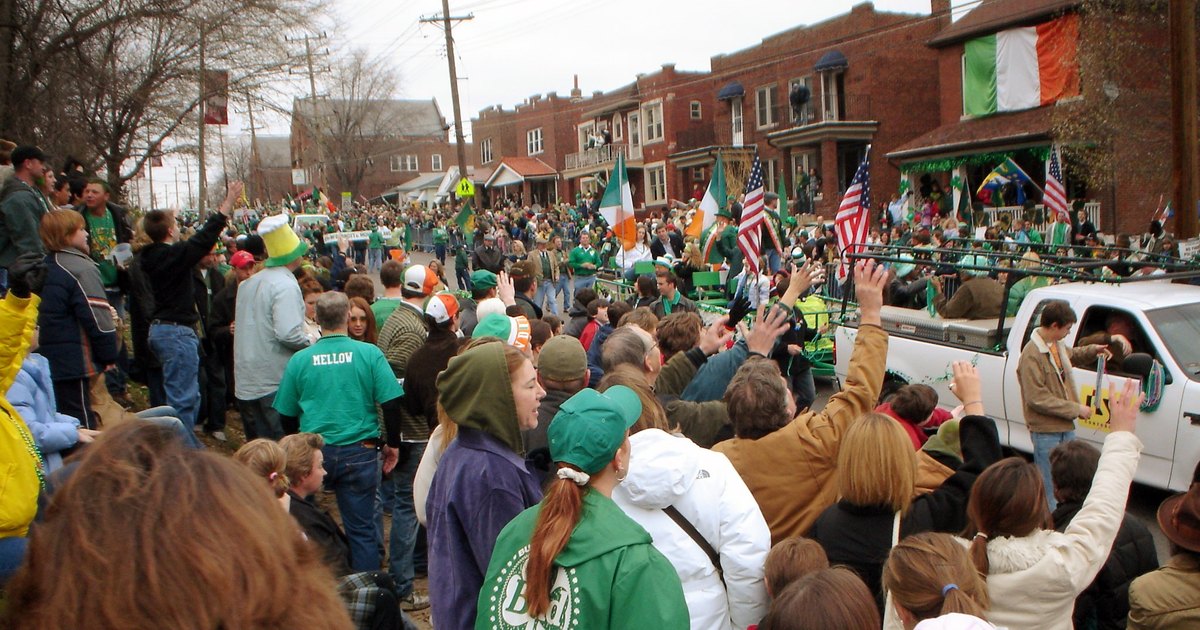
St. Patrick’s Day processions in St. Louis go back at least to the 1870s, when they marched past St. Patrick’s School in the Kerry Patch. The Dogtown parade is much younger than it feels. The Ancient Order of Hibernians, an Irish Catholic fraternal society, started it in Clayton in 1984. Two years later they moved it to Tamm Avenue and it never left. The neighborhood is what gives the parade its weight: the route runs from Oakland Avenue south past St. James, the same street the miners’ families walked to Mass, through blocks that by then also held Italian, German and Polish families who had come for the same clay.
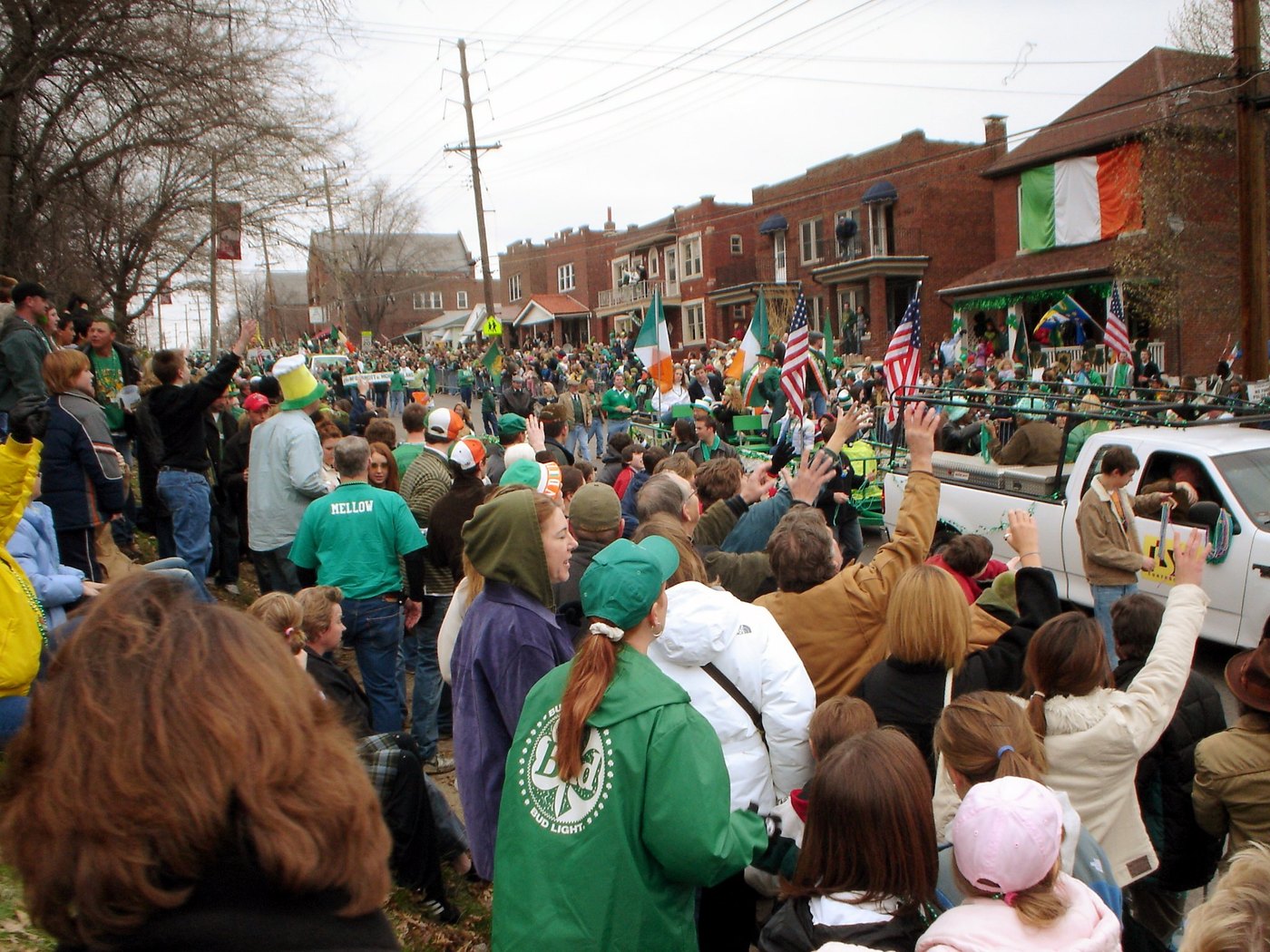
Today: The parade steps off at 11 a.m. every March 17, led in recent years by the Budweiser Clydesdales and followed by close to a hundred floats, pipe bands and dance schools, with a street festival running from morning until evening. It marked its fortieth year in 2024. Tens of thousands come, almost none of them from Cheltenham’s mines, and the parish at the center of the route still hosts the day.
One City, Five Calendars
Each of these traditions grew and adapted with the communities that brought them. They have outlasted the languages that they were first celebrated in, and Saint Louis has added its own flavor to each of them. What they share is the thing immigrants do first and hold onto longest: they build a church, and then they fill its calendar with the days that made the old place feel like home.
This was all built around the churches. They were where people married and were buried, where the children learned English and the grandparents kept the old tongue, where a street in an American industrial neighborhood could, one afternoon a year, feel like a village in Saxony or Lombardy or Jalisco. The children grew up, the neighborhoods changed hands, and some feasts faded. The ones in this story did not. If you are in Florissant or Dutchtown in June, on The Hill in March, in Ferguson on December 12 or anywhere near Tamm Avenue on the 17th, you can still walk in them.
What feast day or parish tradition does your family remember? A procession, a patron saint’s festival, a parish picnic, a dinner that filled the church hall once a year. Those memories are part of this history too, and we would like to hear them.