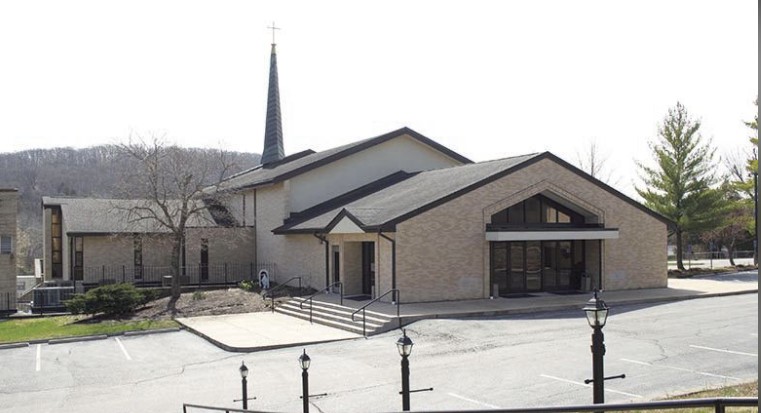
On Easter Sunday morning — April 2, 1972 — three bells rang out over House Springs for the first time. To anyone passing by, it was simply a beautiful sound. But the people of Our Lady Queen of Peace heard something more — because each of those bells carries the voice of a different chapter in a story more than a century in the making.
To understand why, you have to go back to the very beginning.
Irish Roots Along the Meramec
In the early 1800s, Irish Catholic families began settling the rolling countryside between the Meramec and the Big River. They cleared land, raised families — and wanted a place to worship. In 1843, Bishop Peter Kenrick, who would become the first Archbishop of Saint Louis, established the first parish to serve them: Saint Patrick’s Armagh, a little church on the Meramec River about four miles south of Pacific.
As the settlement grew, one church was no longer enough — and Saint Patrick’s was no longer in the center of things. A new Saint Patrick’s went up, and with it a second church: Saint Columbkille, built in Byrnesville near present-day House Springs. For years both were tended from Saint Patrick’s, with priests riding out to say Mass. Not until 1880 did Saint Columbkille receive a resident pastor of its own, Fr. William Gallagher.
Two Country Churches
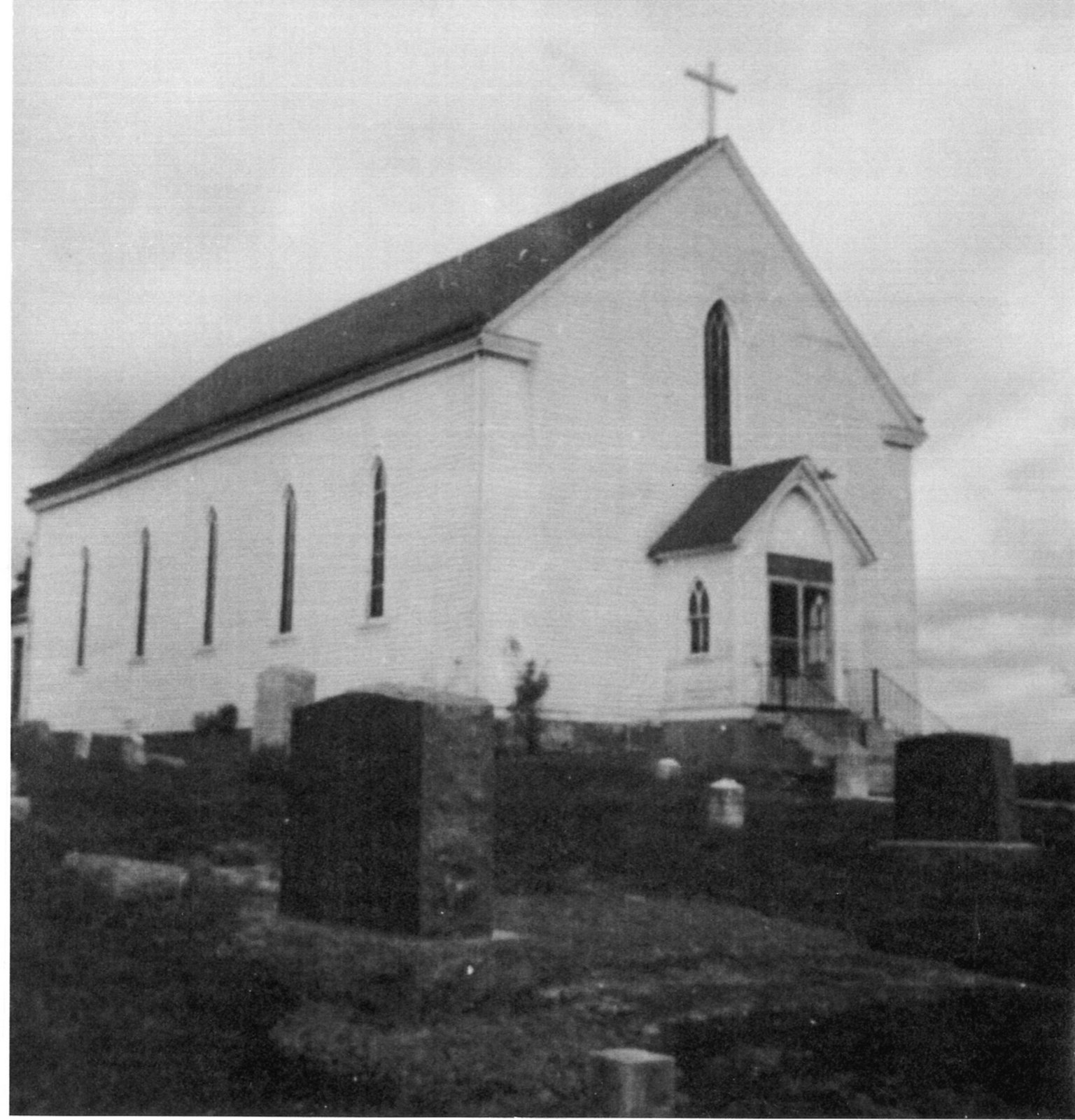
Saint Columbkille Church in Byrnesville — one of the two country churches that became Our Lady Queen of Peace.
In 1905, a second church rose closer to town: Saint Philomena’s, built in House Springs as a mission of Saint Columbkille. For the next four decades the two little churches served their farming communities side by side — through the First World War, the Great Depression, and the Second World War. During the war years, Fr. Jeremiah Murphy shepherded both parishes at once, a duty he carried faithfully until his retirement in 1955.
In 1948, Saint Philomena’s finally became a parish in its own right, welcoming Fr. Joseph Dwyer as one of its first pastors that April. Saint Columbkille carried on as it always had — steady, small, and close-knit.
A Highway Changes Everything
Then the modern world arrived, paved and numbered. The construction of Highway 30 suddenly put Saint Louis within an easy drive, and subdivisions began spreading across the hills of northern Jefferson County. House Springs boomed, and Saint Philomena’s pews filled with new families — while out in the countryside, Saint Columbkille’s congregation held steady or slowly thinned, as many longtime families found themselves closer to newer churches in Rock Creek and Kimmswick.
In 1956, Fr. James Curtin came to Saint Philomena. A year later, when Saint Columbkille’s pastor, Fr. Joseph O’Brien, was called away to military service, Fr. Curtin took the older parish under his care as well. Without anyone quite planning it, the two congregations were already becoming one.
One Parish, A New Name
On September 18, 1959, it became official: Saint Philomena and Saint Columbkille would join together as a single parish. Ground was broken for a new church on April 10, 1960, and on July 20, 1961, Cardinal Joseph Ritter dedicated the building under a new name chosen for a new era — Our Lady Queen of Peace. That September, Fr. Thomas Woracek arrived as pastor of the young parish, beginning a tenure that would shape it for decades.
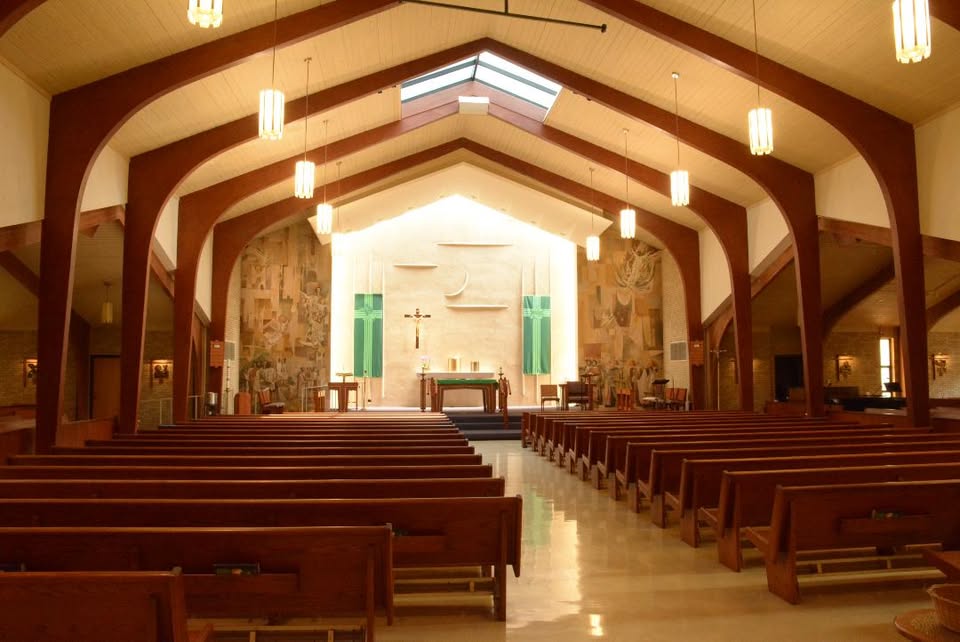
Inside Our Lady Queen of Peace — the church dedicated by Cardinal Ritter in 1961.
Three Bells, One Voice
Which brings us back to those bells.
In December 1971, as the parish celebrated Fr. Woracek’s Silver Jubilee, work began on a 35-foot bell tower — and the bells chosen to fill it each have something to say for themselves.
The two older bells were both cast in 1905 by the Stuckstede Bell Foundry of Saint Louis. The Saint Columbkille bell, tuned to F sharp, carries a farming community’s prayer right on its bronze: “To St. Patrick, Bridget & St. Columbkille, the children of your faith present this bell … bless us and our field.” The Saint Philomena bell, tuned to C and dated Christmas Day 1905, introduces itself by name: “I am called St. Filomena, Virgin and Martyr.” And joining them came a brand-new toll bell, tuned to B and consecrated at Our Lady Queen of Peace, bearing the simplest inscription of all: “Our Lady Queen of Peace, pray for us — Easter Sunday, April 2, 1972.”
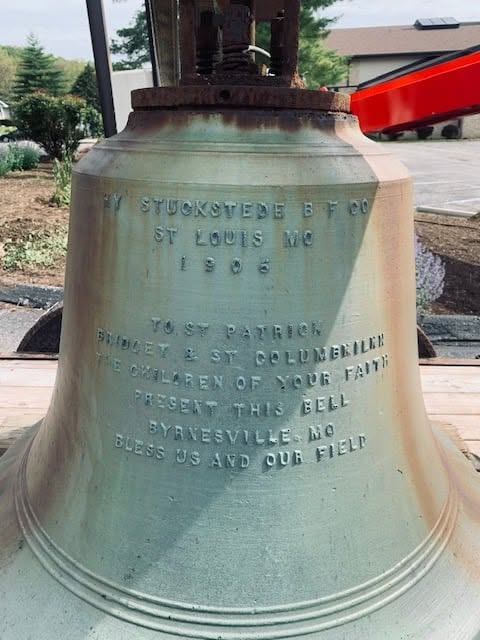
The Saint Columbkille bell, 1905
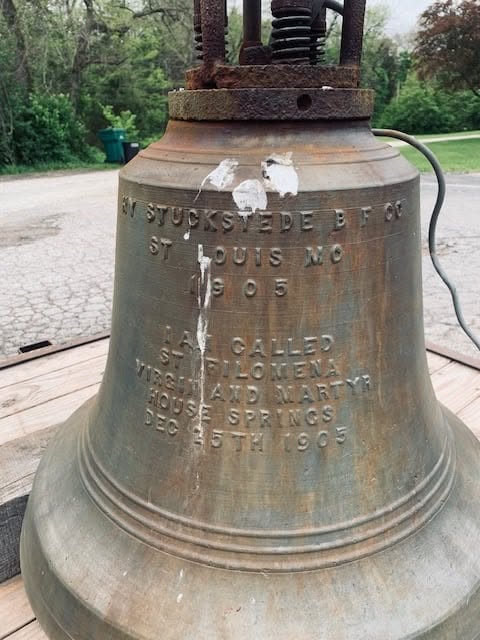
The Saint Philomena bell, Christmas 1905
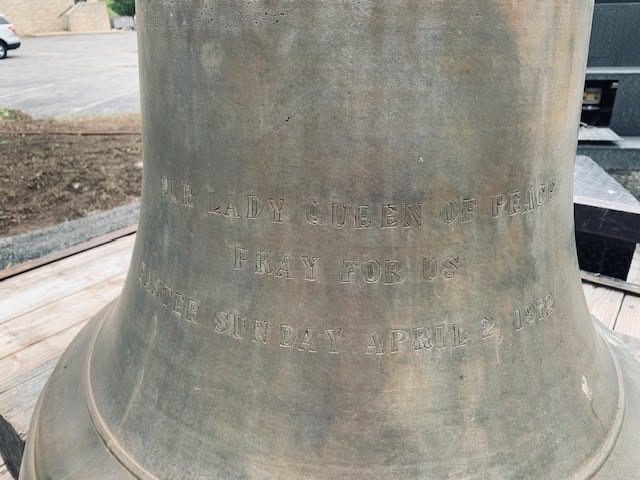
The new toll bell, Easter 1972
Two bells from two old country churches, and one born in the new parish they became — ringing together for the first time on Easter Sunday, 1972.
A memorial plaque on the tower’s concrete base tells the story to this day. Every time the bells ring, the whole history of the parish rings with them.
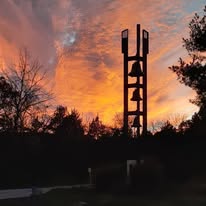
The bell tower at sunset.
A Living Parish
In the years since, Our Lady Queen of Peace has grown into the spiritual home for Catholics across a wide stretch of Jefferson County. By its 25th anniversary in 1986, the parish supported a thriving school, a large Parish School of Religion, and a network of service and faith-formation groups carrying its spirit well beyond the parish walls. It marked its 50th anniversary in 2011 and launched a Strategic Plan for Renewal and Growth the following year. And though declining enrollment brought the parish school’s final bell after the 2018–2019 school year, the community it built endures.
From Irish settlers on the Meramec to the families filling its pews today, Our Lady Queen of Peace remains what it has always been: a vibrant community of faith, a caring family of believers, and a witness to what happens when neighbors build something together — and keep it ringing.